Cryptoverso
One of three finalists — SIAT Award 2026
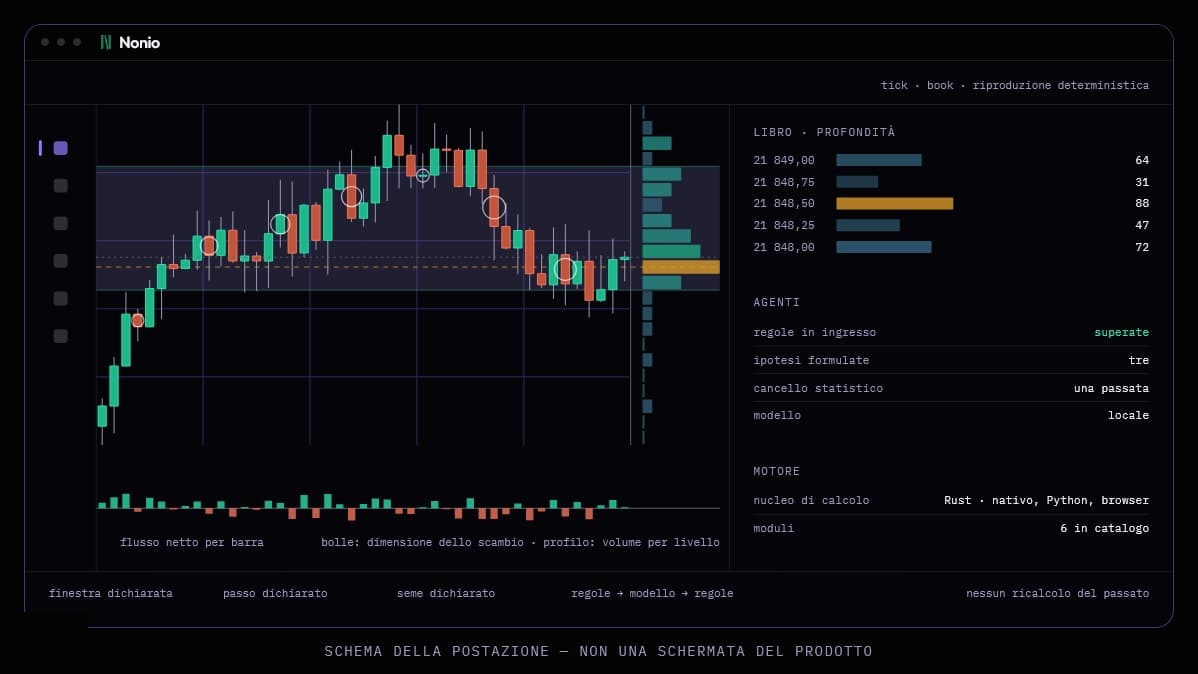
cryptoverso.net is the digital home of Cryptoverso: quantitative market research, training and analysis software. Logika.studio builds all of it — architecture, development, technical content, infrastructure — guided by a single criterion: a visitor must be able to verify the research themselves, by opening a notebook and running its code, instead of trusting a promise. The site is bilingual Italian and English by design, publishes 29 executable notebooks accompanying the book “La matematica di chi perde” (21 labs and 8 calculators) with figures actually produced by the code, presents the Nonio analysis workstation and its six modules, and runs the members area, publications, courses and editorial newsroom. The regulatory perimeter is not left to good intentions: in Italy investment advice is a reserved activity and public recommendations fall under the MAR regulation, so the line between research and operational advice is guarded by automated checks that read both text catalogues and notebook prose in both languages. The research “A Falsificationist Cycle Analysis of Cryptocurrencies”, published on the site, is one of the three finalist works for the SIAT Award 2026 — the fortieth-anniversary edition of the Italian Society of Technical Analysis, founded in Milan in 1986.
The problem
A market research project faces two problems that compound each other. The first is credibility: saying “our method is verifiable” costs nothing, and a reader has no way to tell serious research from a marketing page. The second is regulatory: in Italy investment advice is reserved to registered advisers and public recommendations fall under the MAR regulation, so one careless sentence — or an English translation that turns a descriptive “compro” into an imperative “buy” — pushes the site outside its perimeter. On top of that comes the constraint of print: the short codes behind the book’s QR codes are already on paper, and paper cannot be updated.
How we tackled it
Verifiability was made a technical fact rather than a claim. The notebooks are executed in the public research repository, their real outputs are captured into a versioned bundle, and the site validates and renders it: the figure a reader sees is the one the code produced, not a screenshot. For the regulatory perimeter we wrote an automated check that reads both the text catalogues and the notebook prose, in Italian and English, and blocks publication when recommendation-style language appears. Every public statement — the book title, list prices, company details, the status of each module — lives in a single typed source, so that false information cannot even compile: a module in prototype cannot declare itself “live” by accident.
Technical choices
Next.js 16 with the App Router, React 19, TypeScript and Tailwind CSS v4; next-intl for the two languages; Supabase for authentication and data, with row-level policies covered by dedicated tests; Resend for transactional email. Content is always server-rendered: Markdown goes through a server-side unified pipeline, formulas are compiled with KaTeX at build time and charts are server-generated SVG — the browser receives CSS and fonts, zero JavaScript, and the text exists in the initial DOM for search engines. The build has been standalone from day one, so hosting can change without a rewrite. Beyond lint, types, Vitest and Playwright with accessibility audits, publishing goes through 39 domain gates: regulatory perimeter, notebook bundle integrity, static routes and printed-QR redirects, price list consistency, standalone build health.
What it includes
A complete bilingual site: home, the Nonio platform showcase with its six modules and the declared status of every feature, courses, publications, the book, the 29 executable notebooks, a newsroom with news and data sheets, mission, glossary and legal area. Members area with sign-up and login, publications for registered users, watermarked PDF documents, newsletter and booking. The redirects behind the printed QR codes remain valid by contract, watched over by a gate. The SIAT recognition is shown on the page and in structured data with the only established fact — the podium — because the ranking has not been announced yet: on announcement day a single value changes in a single place. Development, technical content and ongoing management stay with Logika.studio.