Partecipa

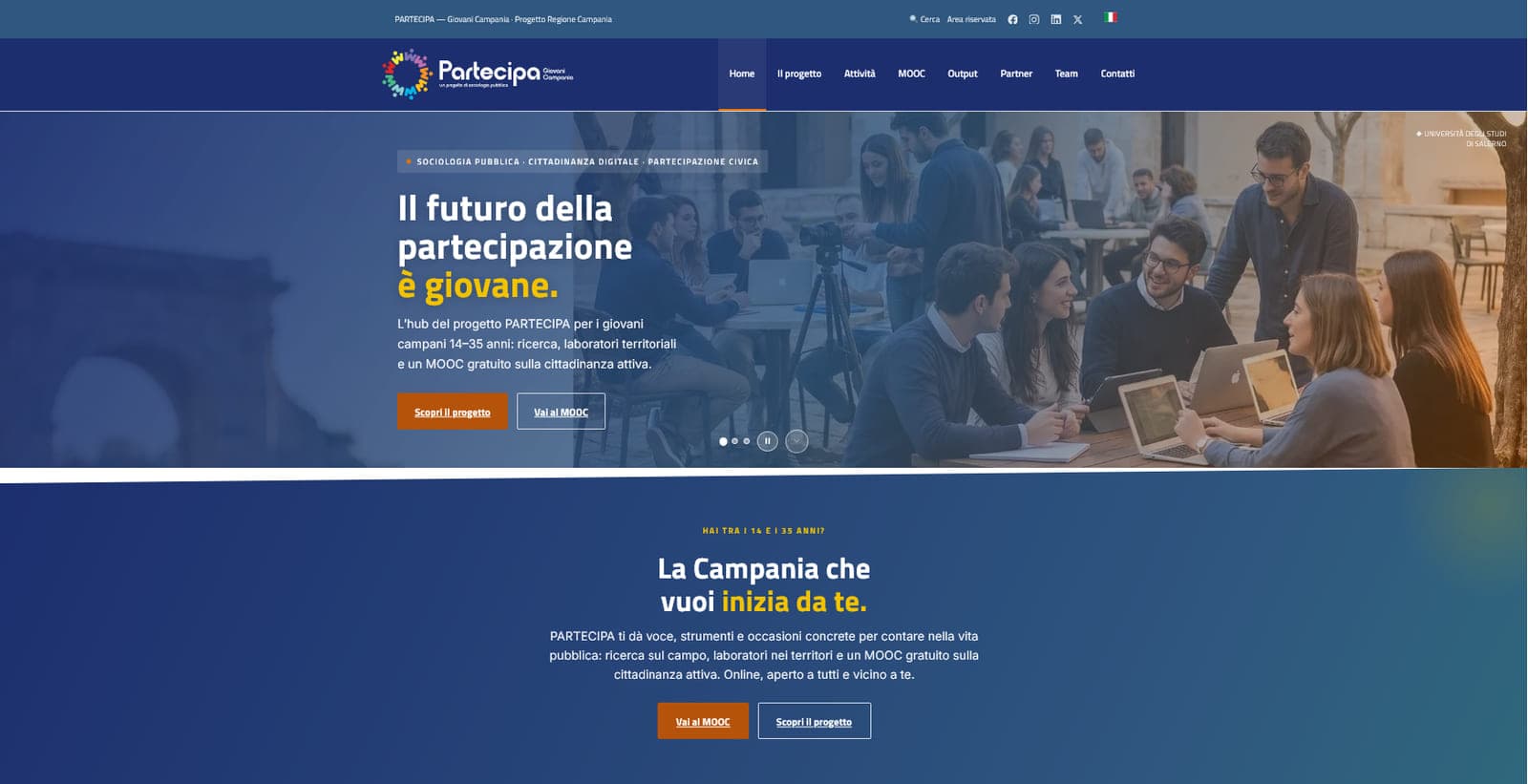
PARTECIPA — Giovani Campania is the official website of the public-sociology project run by the University of Salerno (DISUFF Department / DiSoSW Lab), funded by the Campania Region and aimed at young people in Campania aged 14 to 35. Live since 31 July 2026, the platform serves two purposes: it is the project's public hub — identity, goals, research, four territorial labs with an interactive map of the network across Campania, partners, open-access outputs and events — and it delivers a free MOOC of roughly 15 hours (4 modules) inside the site itself, with no dependency on an external LMS. The members area handles participant registration, lesson-by-lesson progress, end-of-module tests, downloadable handbooks and podcasts and the final PDF certificate, with native completion tracking mirrored automatically between the Italian and English versions of the course. We produced the entire learning content in-house with an AI generation pipeline: 28 video lessons per language (introduction, five units and conclusion per module) with synthetic narration, generated concept illustrations, subtitles and transcripts, 8 in-depth podcasts per language, four branded PDF handbooks and 42 multiple-choice questions; the course presentation video is delivered by a presenter generated with Veo 3.1. The site is fully bilingual Italian/English with curated translations (no runtime machine translation), verified against WCAG 2.1 AA with zero axe violations in both languages, and GDPR-compliant: self-hosted consent banner with Consent Mode v2, analytics blocked before consent and zero external service calls on course pages. The work is rounded out by performance tuning (WebP images, caching, CLS reduced to zero), technical SEO with sitemap and Search Console, and security hardening with firewall and 2FA. The visual identity follows the university's brand guidelines and institutional co-branding (UNISA, Campania Region, Youth Policies).
The problem
A university project funded by the regional government had to reach young people aged 14 to 35 with a free training path, in Italian and English, without relying on an external LMS — which would have meant dependencies, recurring costs and learner data outside the university's control. It needed an institutional site that was also a complete, accessible, compliant course.
How we tackled it
The site is both the project's public hub — research, regional labs with an interactive map, partners, open-access outputs, events — and the delivery platform for a free ~15-hour MOOC in four modules, built into the site itself. The members' area follows each participant lesson by lesson, with end-of-module tests, downloadable handouts and podcasts and a final PDF certificate, keeping progress aligned between the Italian and English versions.
Technical choices
The entire teaching content was produced in-house with an AI generation pipeline: 28 video lessons per language with synthetic narration, generated conceptual illustrations, subtitles and transcripts, 8 podcasts per language, four branded PDF handouts and 42 multiple-choice questions; the course trailer is performed by a presenter generated with Veo 3.1. Human-curated translations (no runtime machine translation), WCAG 2.1 AA with zero axe violations in both languages, self-hosted consent with Consent Mode v2 and no external calls on course pages.
What it includes
Bilingual institutional site covering research, regional labs with an interactive map, partners, open-access outputs and events; a built-in ~15-hour MOOC in four modules with members' area, progress tracking, end-of-module tests, downloadable handouts and podcasts and a PDF certificate. Teaching content produced in-house: 28 video lessons per language, 8 podcasts per language, 4 handouts and 42 questions. Verified WCAG 2.1 AA accessibility, GDPR compliance, technical SEO and security hardening.