
PixelFlow
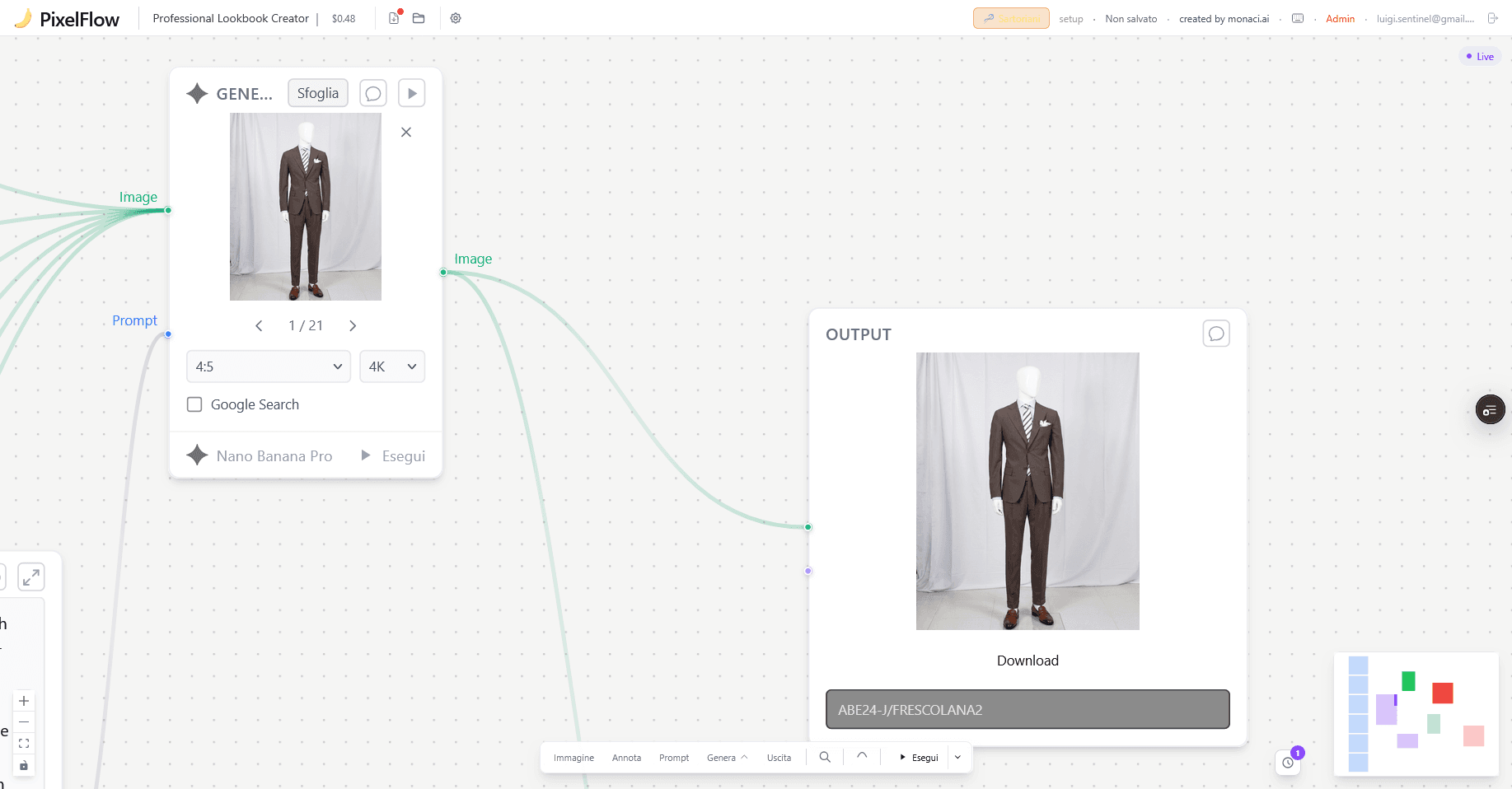
PixelFlow is a visual tool for building and automating creative pipelines: users compose the flow by connecting blocks on a canvas, and the software orchestrates end-to-end execution across multiple AI providers for images, video, 3D and text. Beyond manual workflow composition, it ships automated processes that run entire catalogs in batch mode: the pipeline (label OCR, generation, variants, styling) executes autonomously and human input is only required at the final review, where results are approved or corrected in bulk. It turns manual, repetitive creative processes into reusable workflows, drastically cutting visual production time. It has been used in particular to build fashion-industry automations: lookbook generation, virtual try-on, garment variants across different models and settings, and high-volume social content — in many cases replacing traditional photoshoots.
The problem
In fashion, every variant of a garment — colour, size, model, setting — traditionally means a photo shoot or hours of retouching. Standalone AI generators don't solve it, because the real work isn't the single image: it's the chain that takes you from the garment label to publishable content, repeated across an entire catalogue at consistent quality.
How we tackled it
PixelFlow turns that chain into something reusable: you compose it once on the canvas — label OCR, generation, variants, styling — and from there it runs in batch across the whole catalogue. Human judgement moves to the end, to the review, where results are approved or corrected in bulk rather than one at a time, by the people who actually know the brand.
Technical choices
Node canvas built on React Flow with Zustand state, so the graph stays editable while execution runs; Three.js and Konva.js for 3D previews and image editing; several AI providers behind one interface — images, video, 3D, text — each used for what it does best, without tying the pipeline to a single vendor. App on Next.js 16 and React 19.
What it includes
Visual node editor with saved, reusable flows, batch execution across entire catalogues, 3D preview and in-browser image retouching, several AI providers for images, video, 3D and text, and a review queue with bulk approval and correction. Fashion use cases already covered: lookbook generation, virtual try-on, garment variants across models and settings, and high-volume social content production.