
Your data already knows what is about to happen
Every company that sells, invoices or delivers services is accumulating the answer to the questions it asks itself every month: which customers am I about to lose, which movements are anomalous, how much will I sell next quarter, who deserves credit. We extract those answers with a proper statistical method — real validation, uncertainty stated — and put them where decisions are made.
We turn the data your company already produces — ERP, CRM, e-commerce, invoicing, support tickets — into forecasts you can act on: which customers are about to leave and how much revenue it is worth keeping, which transactions look anomalous, how much you will sell next month and with what margin of error. Models built with a verifiable statistical method: out-of-sample validation, no future data used to explain the past, uncertainty stated and measured rather than hidden behind a single number. And delivered into production — scoring API, drift monitoring, retraining — not in a notebook left on someone's desk.
- ✓We start from the data you already have — ERP, CRM, e-commerce, even spreadsheets: no data warehouse to build before you see the first useful result
- ✓Every forecast comes with its uncertainty stated: an interval and a probability, because no business decision should rest on a single bare number
- ✓Out-of-sample validation with no lookahead: the model is tested on the period it has never seen, under the same conditions it will actually work in
- ✓The model ships to production with a scoring API, drift monitoring and scheduled retraining: when the market shifts you hear it from the system, not from the quarterly results
- ✓Definitions before algorithms: agreeing on what exactly counts as a «lost customer» or a «suspicious transaction» moves the outcome more than any model choice
Type, timeline and stack
| Project type | Churn and retention, fraud and anomaly detection, demand and revenue forecasting, risk and lead scoring, pricing, customer segmentation, decision dashboards |
|---|---|
| Typical timeline | First usable model in 3-6 weeks on existing data; production rollout, monitoring and knowledge transfer in the following 2-4 |
| Typical stack | Python (Polars, scikit-learn, XGBoost/LightGBM, statsmodels, PyTorch), conformal prediction, SHAP, MLflow, PostgreSQL/DuckDB, Prefect/Airflow, FastAPI, Plotly, Metabase/Superset |
Related case studies
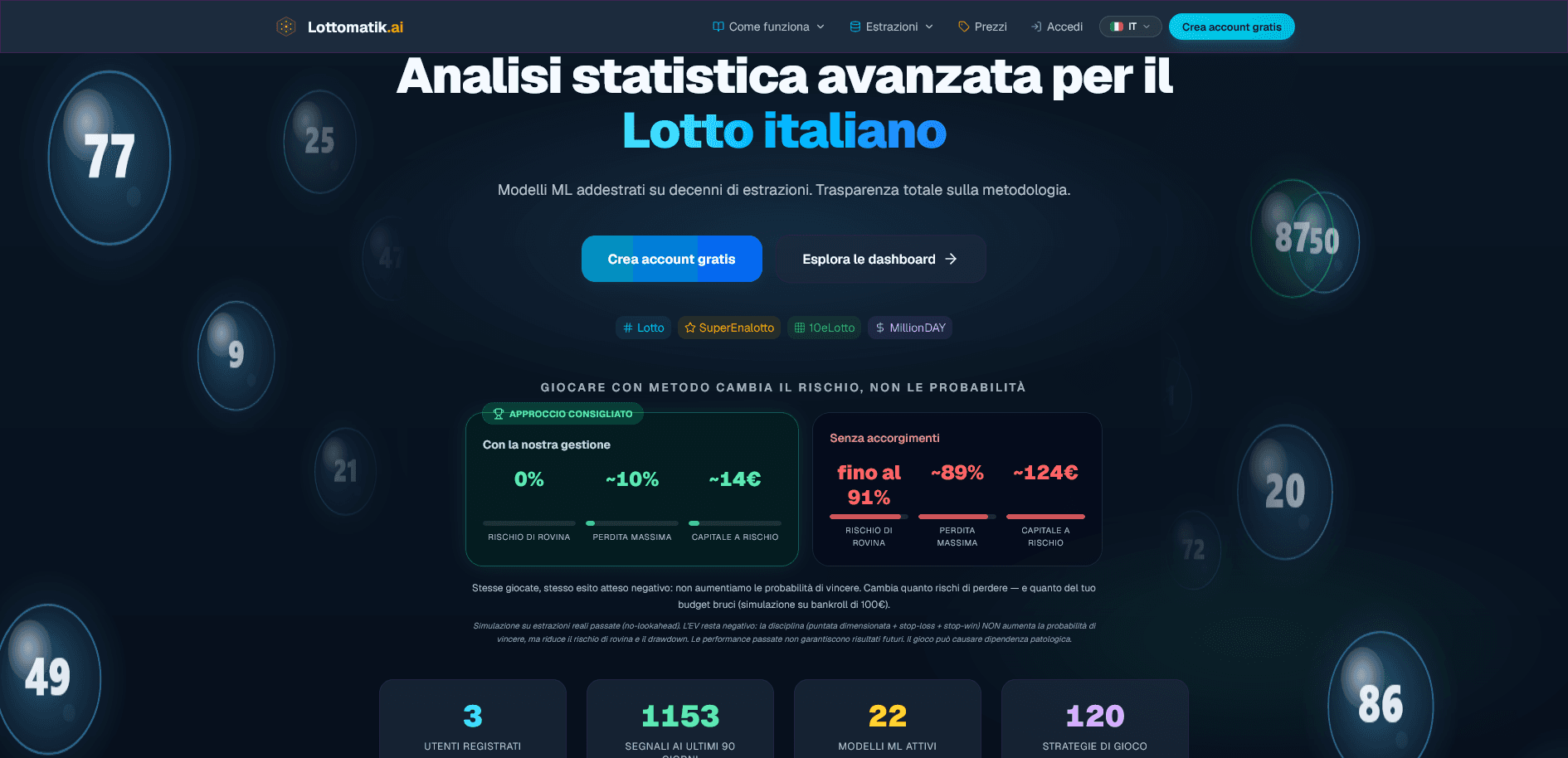
Lottomatikai
A mobile + web ecosystem for the statistical analysis of public numerical time series: native iOS/Android apps with voice AI, an ML web dashboard and a predictive backend. Full-stack end to end.
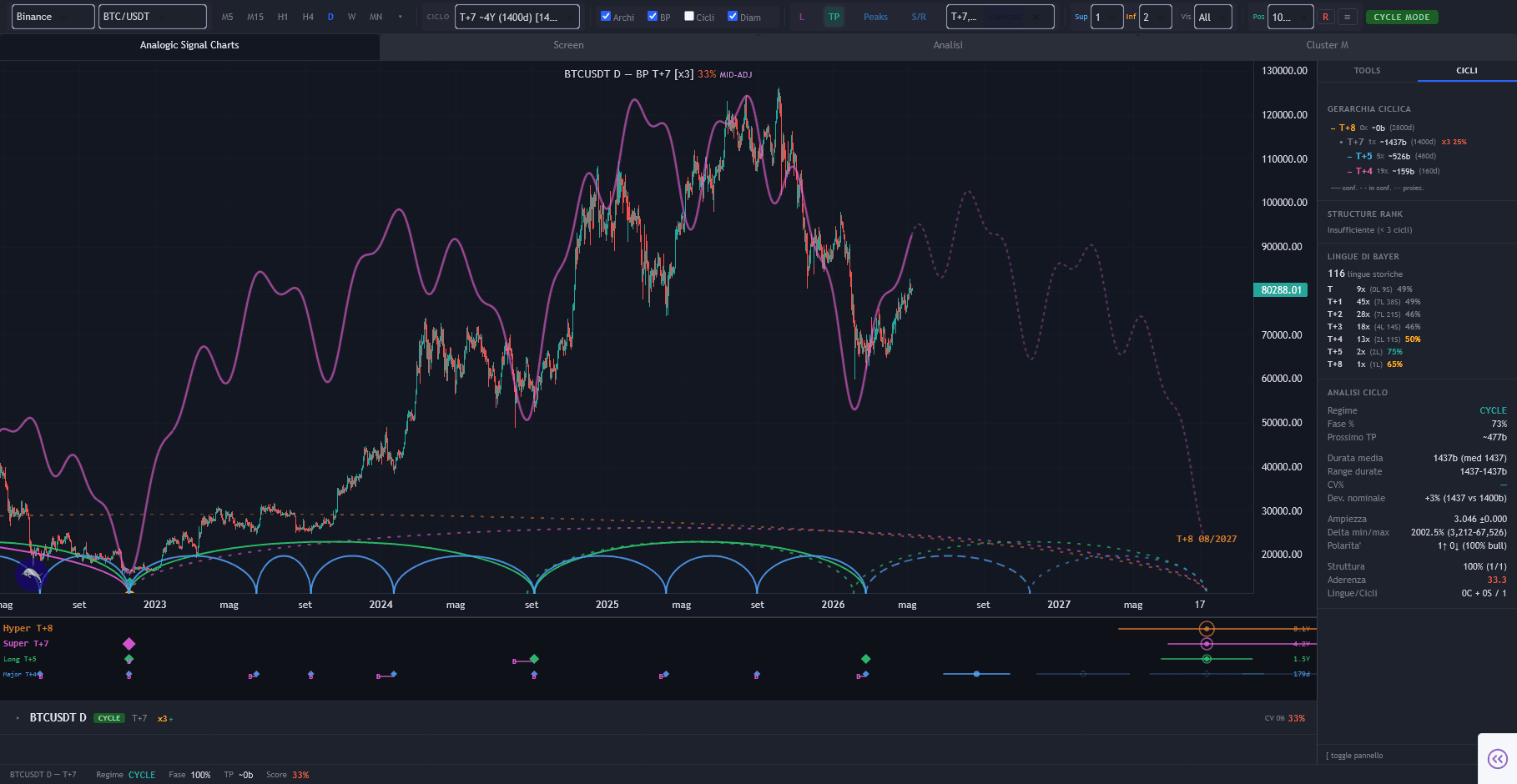
CyclicalResearch
Advanced cyclical analysis platform for crypto. DSP, spectral analysis, regime detection and interactive dashboard. Proprietary.
Frequently asked questions
How much data do we need to start?+
It depends on the question. Churn usually needs a few thousand customers with 12-24 months of history; fraud detection can start with no labelled cases at all, using models that learn normal behaviour and flag departures from it; forecasting needs at least two or three complete seasonal cycles. If the data isn't enough for the question you are asking, we say so before starting rather than handing over a model that looks like it works and doesn't — quite often the first useful phase is fixing how data is collected, not training an algorithm.
How do we know the model actually works?+
Because we measure it the way research measures it, not the way a demo does. The model is evaluated on data it has never seen and in strict time order, never using information that wouldn't have been available in production: that is the most common and most expensive mistake, the one that produces beautiful test accuracy and operational disasters. The metrics we report are tied to your P&L — revenue retained, frauds caught per false alarm, stock saved — and we also check calibration, meaning that when the model says «80% probability» things really do go that way in 80% of cases.
How is this different from your Artificial Intelligence service?+
Generative AI works on text, documents and conversations: chatbots, PDF extraction, semantic search over a knowledge base. Data science works on your structured data and returns numbers and probabilities you decide on: who to contact, how much to order, who to extend credit to, which transaction to block. They often live in the same project — a churn model that scores customers and an assistant that drafts the win-back email — but they are two different crafts and it pays not to confuse them.
Does our data leave the company?+
Only if you decide it should. Processing can stay entirely on your infrastructure or on a dedicated server you control, and in many projects personal data isn't needed at all: we work on pseudonymised identifiers and aggregates. Where processing does fall under GDPR, we agree on legal basis, minimisation and retention before touching the data, not afterwards.
What do we get at the end?+
The model running in production with its scoring API, integrated where it is needed (ERP, CRM, e-commerce); a dashboard or recurring report for whoever has to decide; the code, reproducible and yours; and a document setting out the method, the assumptions and above all the limits — where the model is reliable and where it isn't. If you can't understand how it works, you can't trust it: explainability is part of the delivery, not an extra.
Do you work with banks, insurers and utilities?+
Yes, and that is where the statistical side carries the most weight: credit scoring and default risk, fraud detection on transactions and claims, consumption and load forecasting. In these sectors a model doesn't just have to work, it has to be explainable and defensible: we use attribution techniques (SHAP) to justify every individual score, keep track of model versions and training data, and write down the assumptions, so decisions remain auditable months later.
We already have a BI dashboard — why would we need this?+
BI tells you what happened; models tell you what is about to happen and what is worth doing about it. They complement each other, and often the first piece of work isn't predictive at all: it is sorting out the definitions and the quality of the data your BI already displays — two reports counting customers differently, revenue recognised on different criteria, duplicate records. It is the least spectacular work and the one that pays back the most, because it makes everything built on top of it trustworthy.
How we work
Our agency process in 5 steps
Discovery & Spec
We analyze goals, constraints and KPIs together with the client's product team. We define scope, deliverables and acceptance criteria before estimating — no estimates on fuzzy scope.
Architecture
We design the data model, external integrations and contracts between modules. No code before the map is clear: you save weeks of downstream refactor.
Iterative development
Short cycles with weekly client demos, dedicated branch per feature, continuous code review. Every release is production-ready, not a throwaway prototype.
Review & test
Automated tests, QA checklist, security and accessibility audit before release. No surprises in production, no incidents in the first 48 hours.
Deploy & handover
Production deploy, operational documentation and training for your internal team for full post-project autonomy. You can continue with us or hand off with no hidden dependencies.