Our Services
Custom technology solutions — from digital products for SMEs to algorithmic trading systems for finance professionals
For SMEs & Startups
Software, AI, marketing and SaaS to grow your business
Software Development
Multi-language full-stack studio building custom web, desktop, high-performance backend and distributed systems — from MVPs to enterprise platforms. We cover the entire stack: modern frontend, scalable backend, third-party API integrations, containerization and orchestration for cloud, hybrid or on-premise deployments on any infrastructure.
- Significantly shorter time-to-market compared to traditional development thanks to orchestrated swarms of specialized AI agents
- Modern stack (Next.js 15, React 19, TypeScript, Supabase) maintainable in-house by your team after handover
- Multi-tenant architecture scalable from day one — no costly refactors as you grow
- Full ownership of code and data: zero vendor lock-in, deploy on cloud, hybrid or on-premise
Type, timeline, pricing and stack
| Project type | Web apps, desktop, backend, microservices, third-party API integrations |
|---|---|
| Typical timeline | 4 to 12 weeks for MVP, iterative scaling with recurring releases afterwards |
| Price range | MVP from €15k · Enterprise from €50k |
| Typical stack | Next.js, React, TypeScript, Node.js, C#/.NET, Rust, Supabase, PostgreSQL, Docker, Kubernetes |
Related case studies
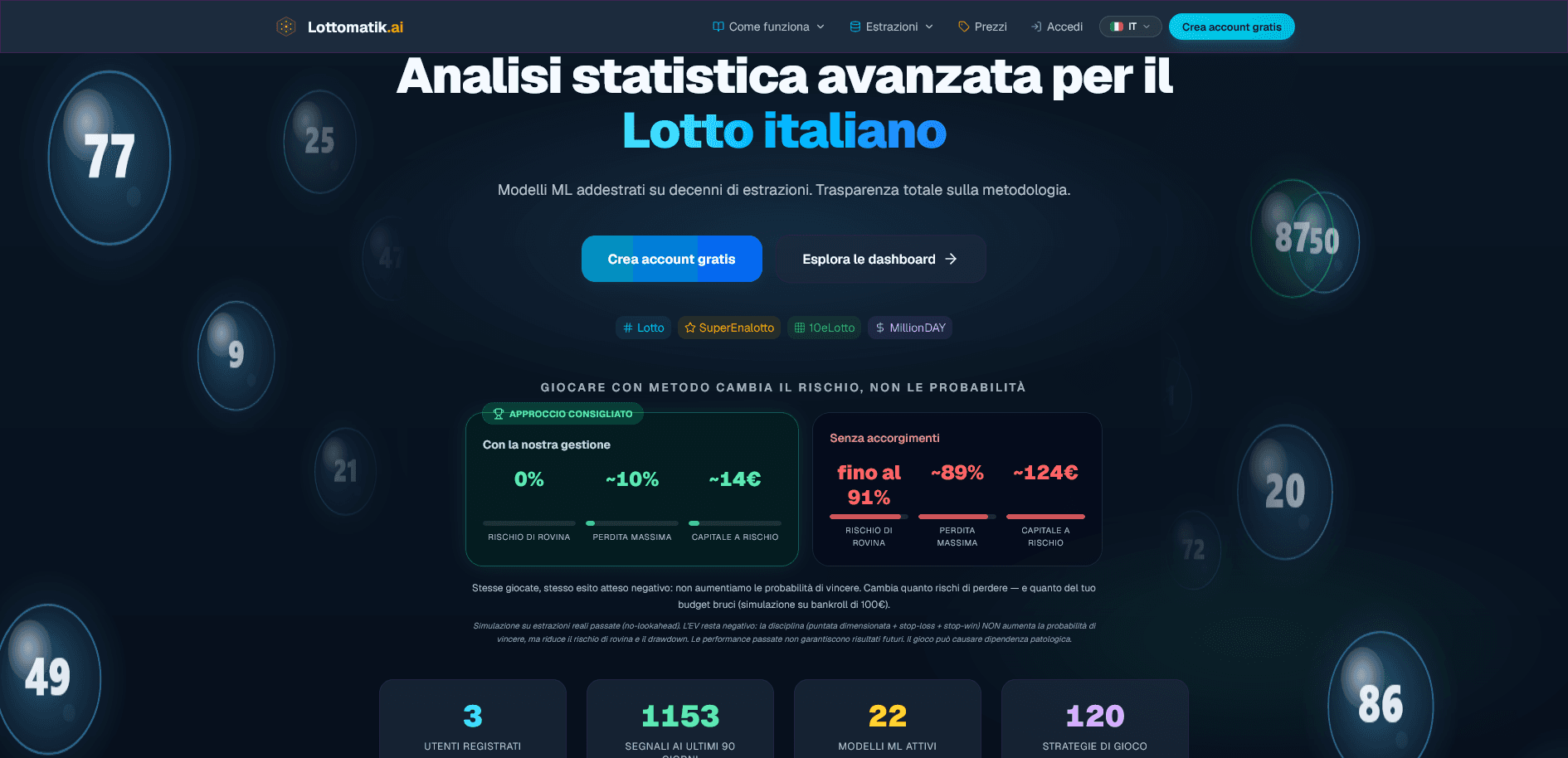
Lottomatik.ai
A mobile + web ecosystem for statistical analysis of Italian lotteries: native iOS and Android apps with voice AI, an ML/AI web dashboard and a predictive backend. Full-stack development end to end.
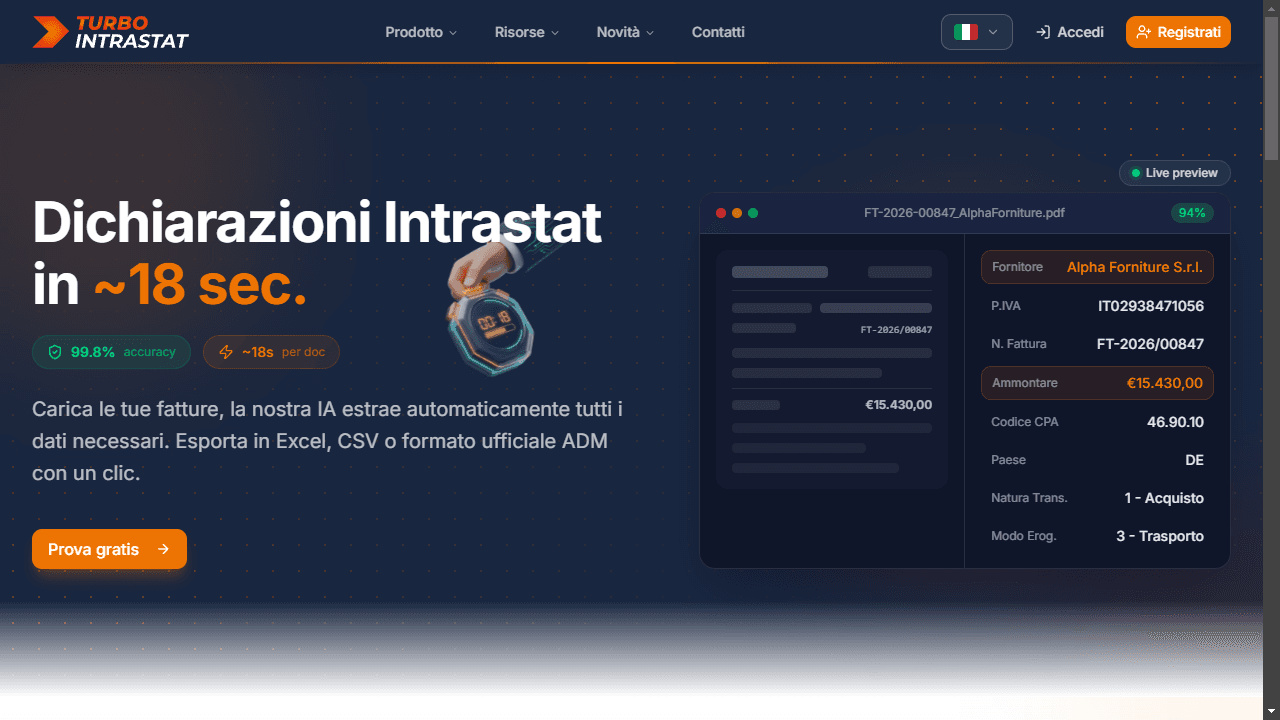
TurboIntrastat
AI-powered SaaS platform to automate Intrastat declarations. Marketing site + webapp live at turbointrastat.com
Artificial Intelligence
We design production-ready AI systems: RAG (Retrieval-Augmented Generation) pipelines with vector DBs and embeddings, multi-agent systems orchestrated with LangChain, LangGraph and Pydantic AI, fine-tuning of open-source LLMs for domain-specific tasks, custom MCP (Model Context Protocol) servers and workflow automation. From chatbots to autonomous agents, from intelligent email/ticket/document classification to semantic search over enterprise knowledge bases.
- Repetitive processes automated without replacing critical human decisions: AI as amplifier, not as a black box
- RAG over private knowledge bases with fine-grained control over what the AI can read and cite in responses
- Multi-LLM without lock-in (OpenAI, Anthropic, Gemini, Mistral, Groq, local Ollama) — switch provider when pricing changes
- Fine-tuning on proprietary data to get answers aligned with your tone of voice and business domain
Type, timeline, pricing and stack
| Project type | RAG, agents, chatbots, document processing, workflow automation, custom MCP servers |
|---|---|
| Typical timeline | 3 to 10 weeks for an agent MVP, continuous iteration on dataset and prompts |
| Price range | POC from €10k · Implementation from €25k |
| Typical stack | LangChain, LangGraph, Pydantic AI, pgvector, Qdrant, OpenAI, Anthropic, Ollama, n8n |
Related case studies
Lottomatik.ai
A mobile + web ecosystem for statistical analysis of Italian lotteries: native iOS and Android apps with voice AI, an ML/AI web dashboard and a predictive backend. Full-stack development end to end.
TurboIntrastat
AI-powered SaaS platform to automate Intrastat declarations. Marketing site + webapp live at turbointrastat.com
Digital Marketing
Data-driven marketing strategies that generate qualified leads and increase visibility both online and across AI assistants. From technical SEO to GEO (Generative Engine Optimization) to get cited by ChatGPT, Perplexity, Claude and Google AI Overviews, through multi-channel paid campaigns, email marketing automation, lead nurturing and advanced analytics.
- Visibility on Google AI Overview, ChatGPT Search and Perplexity through GEO (Generative Engine Optimization)
- Qualified leads instead of vanity traffic: every investment is tracked down to real conversion
- Email marketing automation and multi-step lead nurturing that turns cold contacts into concrete opportunities
- Transparent attribution and reporting: you know exactly where customers come from and what worked
Type, timeline, pricing and stack
| Project type | SEO, GEO, paid ads, email marketing automation, lead nurturing, advanced analytics |
|---|---|
| Typical timeline | Setup 2-4 weeks, monthly retainer recommended for at least 6 months to build solid results |
| Price range | Starting at €1.5k/month |
| Typical stack | GA4, GTM, Search Console, Resend, Brevo, n8n, Ahrefs, Semrush |
Related case studies
SaaS Solutions
We design and develop market-ready SaaS products, from simple apps to complex platforms: custom CRMs, e-commerce systems, vertical management software and operational tools. From multi-tenant architecture to monetization, from onboarding to retention — we build software companies use every day.
- Multi-tenant architecture scalable from day one — Supabase Row Level Security, no rewrites as you grow
- Stripe billing integrated without reinventing it: subscriptions, trials, upgrades/downgrades, webhook for billing events
- Guided onboarding that cuts churn: users see the value within the first 5 minutes
- Product-led growth metrics integrated from day one (MRR, churn, activation, retention cohorts)
Type, timeline, pricing and stack
| Project type | B2B SaaS, B2C SaaS, vertical CRMs, e-commerce, operations software, marketplaces, customer portals |
|---|---|
| Typical timeline | MVP 6-10 weeks, multi-year partnership for post-PMF scaling |
| Price range | Equity + retainer |
| Typical stack | Next.js 15, Supabase RLS, Stripe, Trigger.dev, Resend, PostgreSQL, TypeScript |
Related case studies
Lottomatik.ai
A mobile + web ecosystem for statistical analysis of Italian lotteries: native iOS and Android apps with voice AI, an ML/AI web dashboard and a predictive backend. Full-stack development end to end.
TurboIntrastat
AI-powered SaaS platform to automate Intrastat declarations. Marketing site + webapp live at turbointrastat.com
Mobile App Development
We design and build native iOS and Android apps from a single codebase with React Native and Expo. From concept to App Store and Google Play publishing: backend, on-device and cloud AI, authentication, in-app payments, push notifications and analytics included. A smooth, native experience on both platforms — one team, one budget.
- A single codebase for iOS and Android: no two separate teams, roughly half the cost and time vs pure native
- AI inside the app: from voice dictation to intelligent content interpretation and real-time personalized advice
- Backend, auth, payments and notifications already integrated — the app is ready to scale from the first user
- Real case: Lottomatik.ai, an iOS+Android companion app with voice AI and an ML backend, built entirely by us
Type, timeline, pricing and stack
| Project type | iOS + Android apps, from MVP to full product, mobile companion of existing web platforms |
|---|---|
| Typical timeline | 6 to 16 weeks depending on features, backend and AI integrations |
| Price range | Mobile MVP from €18k · Full apps on quote |
| Typical stack | React Native, Expo, TypeScript, NativeWind, Supabase, FastAPI, FCM/APNs, EAS |
Related case studies
For Finance Professionals
Algorithmic trading systems and quantitative research for trading rooms, investment funds and sophisticated private traders
Algorithmic Trading & Quantitative Research
Institutional-grade quantitative research and algorithmic trading systems across crypto, equities, indices, commodities, forex and derivatives. From advanced cycle analysis (DSP, adaptive filters, spectral analysis, Hurst theory) to Monte Carlo simulations, through to the deployment of automated trading systems on retail brokers, prime brokers and proprietary infrastructure — with integrated risk management, stress testing and real-time monitoring.
- Rigorous backtesting without lookahead bias and without repainting — results that hold out-of-sample
- Full ownership of strategies, code and data: no black boxes, no SaaS provider that knows your alpha
- Deploy on retail brokers (IB, Binance, Bybit) or prime brokers with the same codebase — no refactor when you scale
- Integrated risk management: max drawdown, kill-switch, adaptive position sizing, Monte Carlo stress tests
Type, timeline, pricing and stack
| Project type | Trading systems, backtesting frameworks, alpha research, low-latency infrastructure, risk dashboards |
|---|---|
| Typical timeline | 6 to 16 weeks depending on strategy complexity and multi-asset scope |
| Price range | Under NDA |
| Typical stack | Python, Polars, NumPy, Numba, SciPy, Statsmodels, CCXT, PostgreSQL, C#/.NET |
Trading Rooms & Prop Trading
Low-latency infrastructure for prop trading firms and professional trading rooms: multi-account execution, institutional-grade broker connectivity, centralized risk management and real-time operational dashboards for traders and risk managers.
- Multi-account, multi-broker and multi-strategy execution in parallel
- FIX, REST/WebSocket connectivity to Interactive Brokers, CQG, Rithmic, Binance Institutional
- Centralized risk management: per-strategy limits, max drawdown, automatic kill-switches
- Real-time operational dashboards with P&L, exposure, latency and custom alerting
Investment Funds & Asset Managers
Systematic quantitative research platforms and industrial-grade backtesting for hedge funds, asset managers and investment firms. Development of alpha models, portfolio construction frameworks, risk attribution and compliance reporting (AIFMD, MiFID II).
- Systematic alpha research: factor models, mean-reversion, momentum, statistical arbitrage
- Portfolio construction, risk/return optimization and quantitative risk attribution
- Industrial-grade backtesting with tick-by-tick data, realistic transaction costs and slippage modeling
- AIFMD/MiFID II compliance reporting, daily NAV, performance attribution for investors
Private Traders & Family Offices
Automated trading systems and personal dashboards for sophisticated private traders, HNWIs and family offices: systematic personal capital management with the same rigorous methodology applied in the institutional world, yet accessible and fully owned by the client.
- Automated bots on retail brokers (Binance, IB, Bybit, MetaTrader, TradingView)
- Personal dashboard with equity curve, drawdown, Sharpe, real-time exposure
- Multi-channel alerts (Telegram, email, webhook) and manual trade approval
- Full ownership of code, strategies and data — zero vendor lock-in
Related case studies
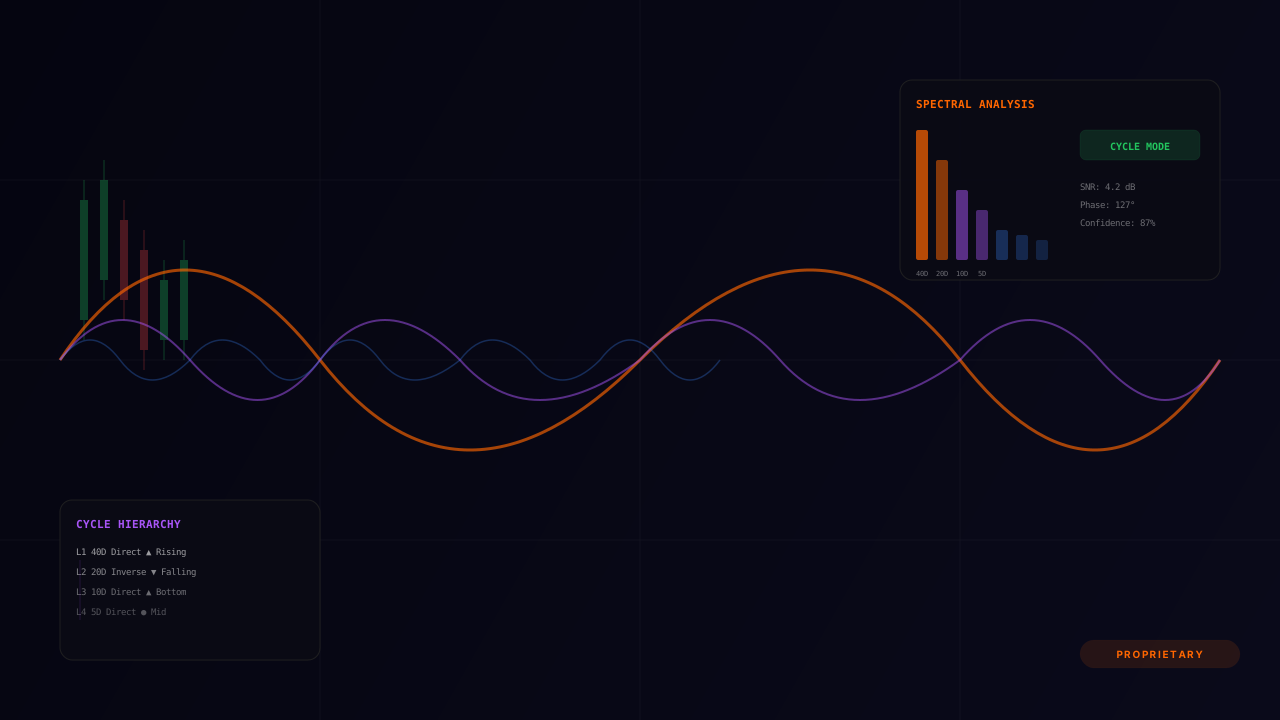
CyclicalResearch
Advanced cyclical analysis platform for crypto. DSP, spectral analysis, regime detection and interactive dashboard. Proprietary.
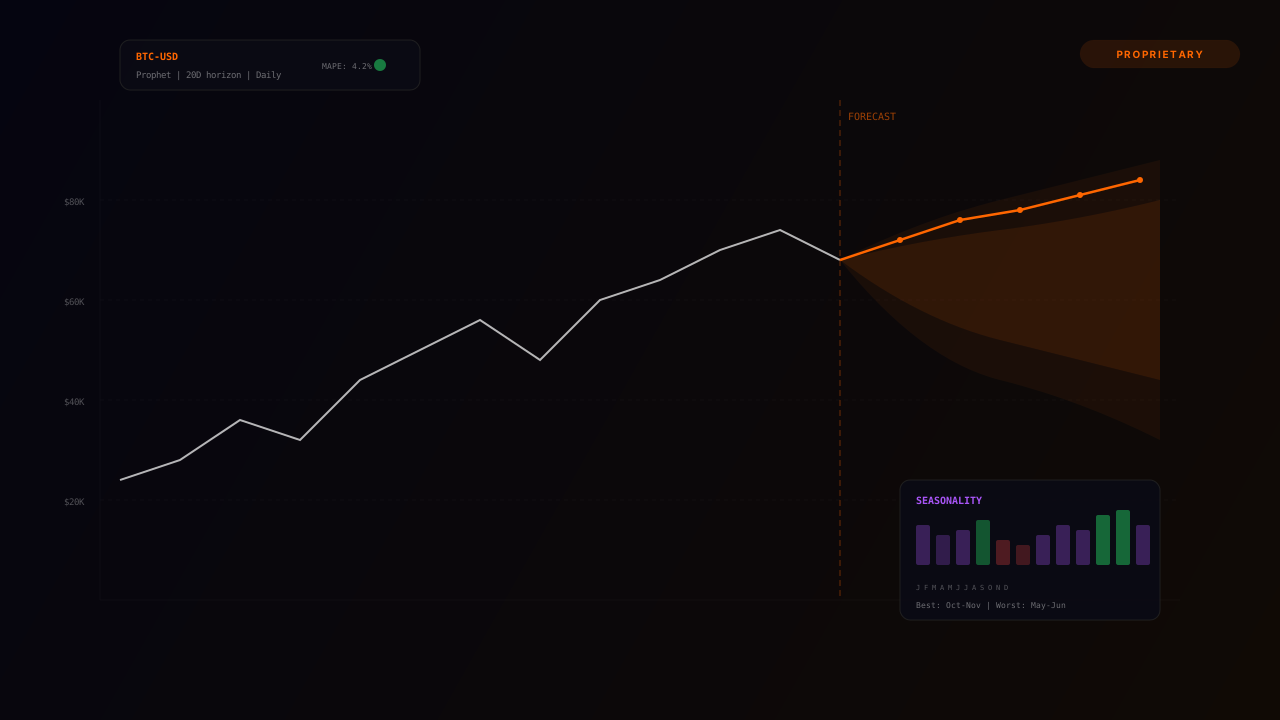
Forecast Engine
Crypto price forecasting engine with Prophet models, seasonal decomposition and cross-validation. Proprietary.
How we work
Our agency process in 5 steps
- 1
Discovery & Spec
We analyze goals, constraints and KPIs together with the client's product team. We define scope, deliverables and acceptance criteria before estimating — no estimates on fuzzy scope.
- 2
Architecture
We design the data model, external integrations and contracts between modules. No code before the map is clear: you save weeks of downstream refactor.
- 3
Iterative development
Short cycles with weekly client demos, dedicated branch per feature, continuous code review. Every release is production-ready, not a throwaway prototype.
- 4
Review & test
Automated tests, QA checklist, security and accessibility audit before release. No surprises in production, no incidents in the first 48 hours.
- 5
Deploy & handover
Production deploy, operational documentation and training for your internal team for full post-project autonomy. You can continue with us or hand off with no hidden dependencies.
Frequently asked questions — Software Development
How much does custom software development cost?+
For a focused MVP we start at €15k. Multi-team enterprise projects start around €50k and scale based on scope, integrations and required SLAs. After a 15-minute exploratory call you'll get a concrete range based on your case, no commitment required.
How fast can you ship an MVP?+
For a focused MVP we typically land in 4-8 weeks. Enterprise multi-team projects run 3-6 months distributed across iterative releases, with weekly client demos.
Who owns the code after delivery?+
You do. All code belongs to you and lives in your private Git repository. No vendor lock-in, no recurring license on the codebase, technical documentation included.
What happens after production deploy?+
We provide operational documentation, training for your internal team and an optional maintenance contract. You can continue with us or hand off to your team with no hidden dependencies.
Which tech stacks do you support?+
We specialize in Next.js 15+, React 19, TypeScript, Supabase, PostgreSQL. For backend and CLI we also use C#/.NET and Rust when it makes sense. For mobile we build native iOS and Android apps with React Native and Expo (see the dedicated Mobile App service).
How do you handle security and personal data?+
GDPR-first by design: data encrypted at-rest and in-transit, Supabase Row Level Security, audit trail and automatic backups. For enterprise projects we run a dedicated security audit before go-live.
Can you integrate legacy systems already in production?+
Yes. We integrate via REST/GraphQL APIs, webhooks, messaging queues or directly at the database layer when needed. We run a preliminary assessment to pick the most robust integration pattern.
Frequently asked questions — Artificial Intelligence
Will my data end up training OpenAI or Anthropic models?+
No, when we use their enterprise APIs (no-training by default) or when we deploy open-source models locally via Ollama or vLLM. We document the data flow in writing before kickoff.
How much does a custom AI system cost?+
For a defined-scope POC (RAG chatbot over internal documents, single-tool agent) we start at €10k. For production implementations with multi-agent, integrations and MLOps we're at €25k and up, scaling with the number of tools and data sources. We provide a concrete quote after discovery.
What is RAG and when is it better than a simple chatbot?+
RAG (Retrieval-Augmented Generation) lets the LLM answer based on your up-to-date documents instead of generic training. It's worth it when accuracy on internal knowledge is critical (support, legal, medical, technical domains).
Can I switch LLM provider after launch?+
Yes, we always architect with an abstraction layer that allows swapping OpenAI, Anthropic, Gemini or local Ollama models without rewriting business logic. Zero lock-in on the provider.
How do you evaluate the quality of generated responses?+
We define evaluation metrics together (relevance, factual accuracy, tone), build a golden test dataset and measure every release against the baseline. No 'it works well' without numbers.
Can you integrate AI into our existing systems (CRM, ticketing, email)?+
Yes, via APIs, webhooks, n8n or custom MCP servers. Solid experience integrating with Supabase, HubSpot, Zendesk, transactional email and internal knowledge bases.
What does deploying a custom MCP server mean?+
MCP (Model Context Protocol) is the open standard that allows Claude, Cursor and other AI tools to securely access internal tools and data. We build MCP servers that expose your internal APIs as tools callable by AI assistants.
Frequently asked questions — Digital Marketing
What's the difference between SEO and GEO?+
SEO optimizes for classic search engines (Google, Bing). GEO (Generative Engine Optimization) optimizes for getting cited by ChatGPT, Perplexity, Claude and Google AI Overview — where users don't click links anymore but read the answer synthesized by the AI.
How much does a digital marketing strategy cost?+
Starting at €1.5k/month for retainer with setup plus continuous optimization. Paid campaigns have separate media budget depending on your market (B2B tech typically CPL €30-150).
How soon will I see SEO results?+
For high-competition queries 4-6 months for solid results, for long-tail and GEO we see signals within 8-12 weeks. We provide monthly reporting with real progress on keywords, impressions, CTR and conversions.
Do you also manage Google Ads and Meta campaigns?+
Yes, multi-channel: Google Ads, Meta, LinkedIn and TikTok. Full tracking setup (GTM, GA4, pixels, enhanced conversions), creative testing and weekly optimization to cut CPL and lift quality score.
How do you measure campaign ROI?+
Server-side attribution when possible (GA4 + backend events), UTM consistency, weekly reporting dashboard with CAC, LTV, payback period. Zero vanity dashboards, only revenue-tied metrics.
What does email marketing automation include?+
Provider setup (Resend, Brevo, Mailchimp), audience segmentation, welcome flow, multi-step nurturing, re-engagement, transactional email. Includes A/B testing on subject lines, send times and CTAs.
Can I switch marketing stack in the future without losing data?+
Yes, we architect with clean export and documented schema. Every tool choice is justified in writing, no hidden vendor lock-in.
Frequently asked questions — SaaS Solutions
What does 'Equity + retainer' mean?+
For selected SaaS products we accept an equity stake + monthly retainer instead of the project-quote model. It's a partnership model: we win if the product wins. Evaluated case-by-case after discovery.
How long does a SaaS MVP take?+
Typically 6-10 weeks for a focused MVP with auth, multi-tenancy, base Stripe billing and the first user workflow. Feature extensions and scaling land in subsequent iterative releases.
Who handles hosting and infrastructure?+
The client typically, with full operational documentation. Default stack: Vercel (frontend), Supabase (auth + DB + storage), Trigger.dev (background jobs), Stripe (billing). Self-hosting on AWS/GCP/on-premise is also an option.
How do you handle multi-tenancy and data isolation?+
Row Level Security on Supabase with per-tenant_id policies, per-tenant audit trail, per-tenant backups. Zero cross-tenant leak risk: policies are tested automatically in CI.
Do you integrate Stripe or another payment processor?+
Stripe is the default (most mature for B2B SaaS), but we also integrate Paddle, Lemon Squeezy and local processors when needed. Full management of webhooks, dunning, proration, tax compliance (Stripe Tax).
Can you maintain the product after launch?+
Yes, ongoing maintenance and evolution retainer is part of the partnership model. Alternatively we transfer operational ownership to your in-house team with dedicated training.
How do you prevent early churn?+
Measured guided onboarding (time-to-first-value), smart transactional emails, usage dashboard and automatic alerts when a user is about to disengage. If there's no PMF, no feature compensates.
Frequently asked questions — Mobile App Development
Do you build for both iOS and Android or just one platform?+
Both, from a single React Native/Expo codebase: the same code produces the app for the App Store and Google Play. You save time and cost versus two separate native builds, while keeping native performance and experience on every device.
How much does it cost to build a mobile app?+
For a focused mobile MVP we start at €18k. Full apps with backend, AI and integrations scale with scope. After a 15-minute call you get a concrete range for your case, no commitment.
Can you integrate AI inside the app?+
Yes, it's our strength: conversational assistants, voice recognition (speech-to-text), ML/predictive models and personalized advice, on-device or via cloud. In Lottomatik.ai we integrated voice dictation and an AI engine directly into the app.
Do you also handle store publishing?+
Yes. We manage builds (EAS), certificates, App Store and Google Play listings, the review process and OTA updates. You follow the progress, we get the app onto the stores.
Have you already shipped published apps?+
Yes. Lottomatik.ai is an iOS+Android companion app built entirely by us, with an ML backend, voice AI, push notifications and authentication — from concept to the stores.
Who owns the app's code?+
You do. All the code lands in your private repository, no vendor lock-in. You can continue with us or hand maintenance to your internal team, with documentation and training included.
Frequently asked questions — Algorithmic Trading & Quantitative Research
Why do you require an NDA before the quote?+
To discuss strategies, alpha sources and existing infrastructure with the level of detail needed for honest scoping. It's a safeguard for both sides: you protect IP, we work on real information instead of generic assumptions.
Who owns the strategies developed?+
You, 100%. Code, optimized parameters, signals, processed historical data — all yours, in your private repository, with no residual rights or royalties for us. Contractually documented.
How do you avoid lookahead bias and repainting in backtests?+
Absolute rule: never use future data to compute past values. Point-in-time correct pipelines, walk-forward validation, rigorous out-of-sample tests, randomized Monte Carlo on gaps and slippage. Every assumption documented.
Which brokers and exchanges do you deploy on?+
Experience across Interactive Brokers, Binance (spot + futures), Bybit, CQG, Rithmic, MetaTrader. REST/WebSocket and FIX connectivity for institutional brokers. Prime broker deploy evaluated case-by-case.
How do you handle operational risk management?+
Per-strategy limits (max position, max exposure), kill-switch on intraday max drawdown, circuit breaker on latency degradation, automatic broker vs internal P&L reconciliation, multi-channel alerting (email, Telegram, webhook).
Where do you source clean historical data?+
Multi-source: tick/bar from institutional brokers, Polygon, Binance archive, CCXT histories, premium vendors for equities. Documented cleaning pipeline (gap handling, split adjustment, timezone-aware, no survivorship bias).
Can you integrate machine learning models into strategies?+
Yes, with discipline: point-in-time feature engineering, walk-forward validation, probability calibration, rigorous backtest. ML is useful when it improves the baseline, not because it's ML — we decline projects where the client wants ML as marketing with no baseline.
Prefer a phone call?
+39 379 3645981