Artificial Intelligence for your business
RAG pipelines, multi-LLM agents, custom MCP servers. AI as amplifier for your team, with full data ownership.
We design production-ready AI systems: RAG (Retrieval-Augmented Generation) pipelines with vector DBs and embeddings, multi-agent systems orchestrated with LangChain, LangGraph and Pydantic AI, fine-tuning of open-source LLMs for domain-specific tasks, custom MCP (Model Context Protocol) servers and workflow automation. From chatbots to autonomous agents, from intelligent email/ticket/document classification to semantic search over enterprise knowledge bases. We pair the technical work with hands-on AI training for your teams and with integrating assistants into the processes and software you already use.
- ✓Repetitive processes automated without replacing critical human decisions: AI as amplifier, not as a black box
- ✓Teams that know what to delegate to AI, how to check its output and which data not to share, thanks to training built on their own real cases
- ✓RAG over private knowledge bases with fine-grained control over what the AI can read and cite in responses
- ✓Multi-LLM without lock-in (OpenAI, Anthropic, Gemini, Mistral, Groq, local Ollama) — switch provider when pricing changes
- ✓Fine-tuning on proprietary data to get answers aligned with your tone of voice and business domain
Type, timeline and stack
| Project type | RAG, agents, chatbots, document processing, workflow automation, custom MCP servers, team training, integration into existing systems |
|---|---|
| Typical timeline | 3 to 10 weeks for an agent MVP, continuous iteration on dataset and prompts |
| Typical stack | LangChain, LangGraph, Pydantic AI, pgvector, Qdrant, OpenAI, Anthropic, Ollama, n8n |
Related case studies
Cryptoverso
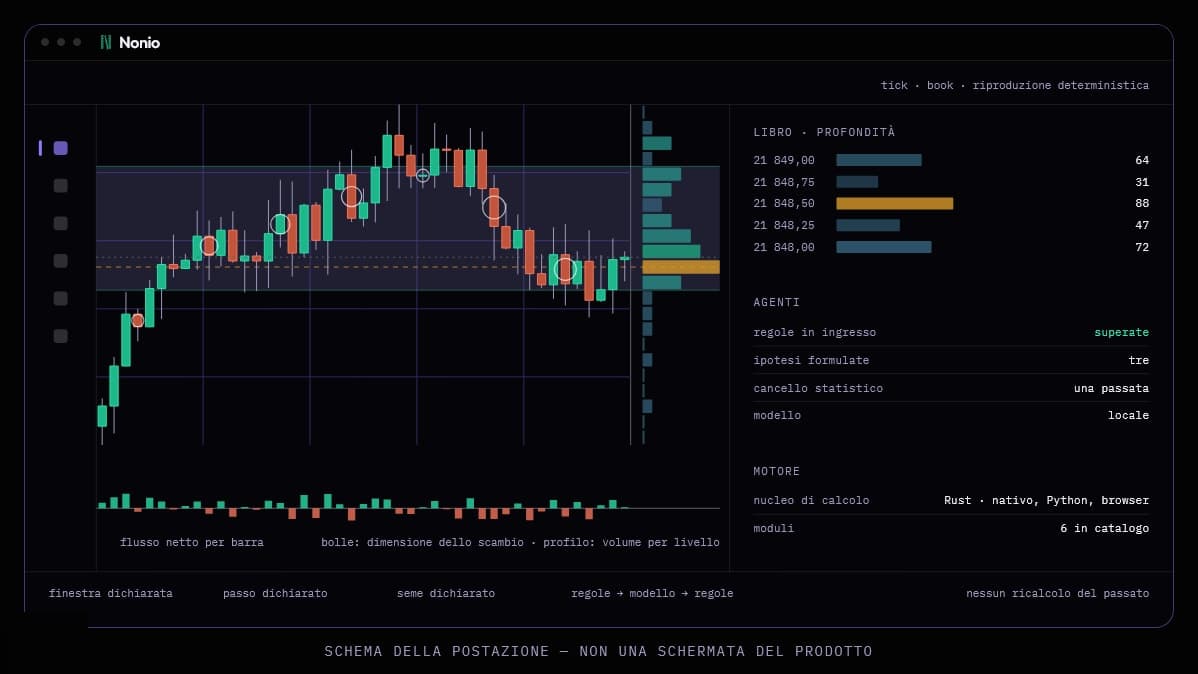
Quantitative market research, training and analysis software: a bilingual site with 29 executable notebooks, a members area and the showcase of the modular Nonio workstation. The published research won first prize at the SIAT Award 2026, Open category.
Partecipa
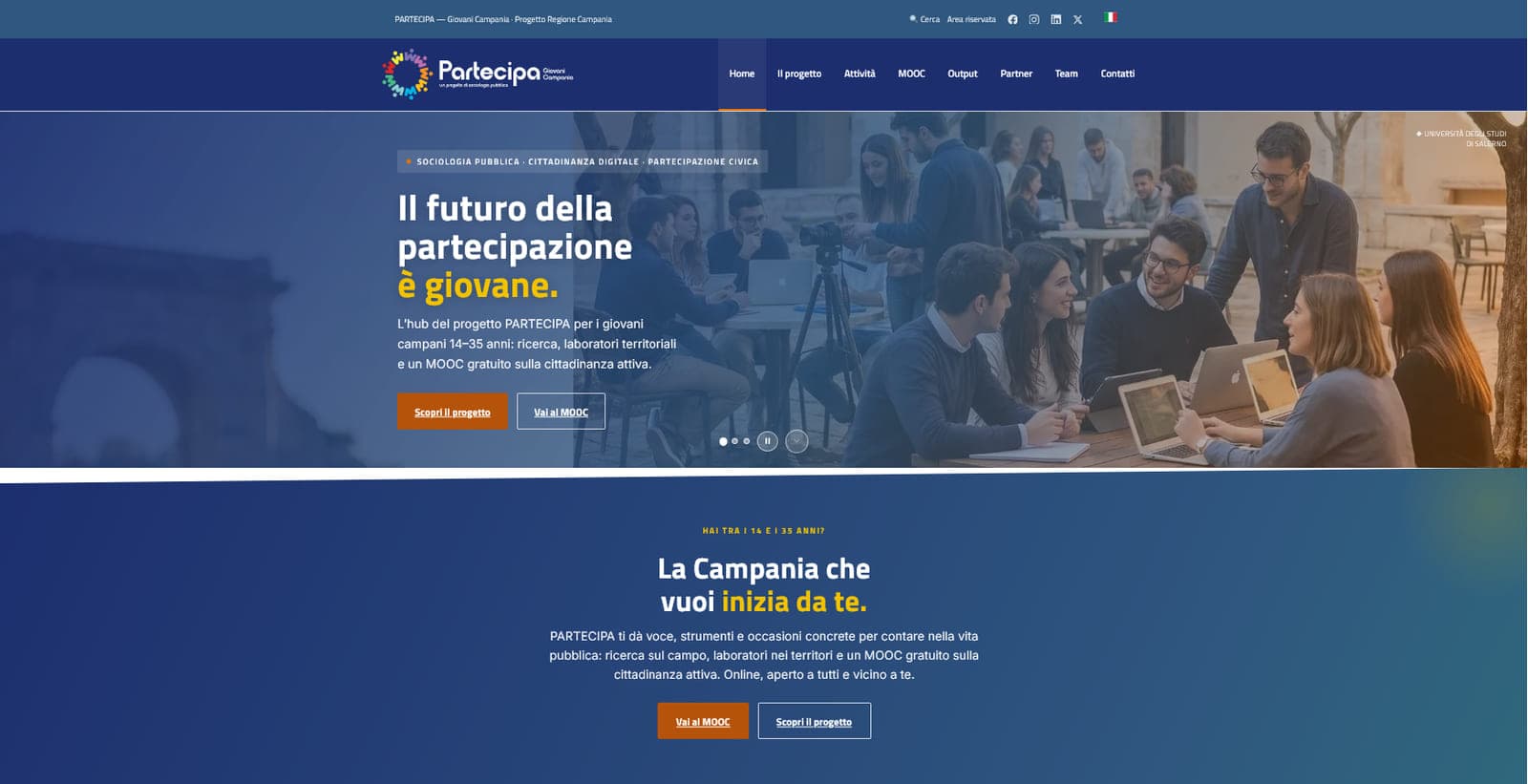
Bilingual institutional platform for the PARTECIPA project of the University of Salerno, funded by the Campania Region: public website plus a free 15-hour MOOC delivered inside the site, with a members area and a certificate. Video lessons, podcasts and an AI presenter produced entirely in-house with a generative pipeline.
Frequently asked questions
Will my data end up training OpenAI or Anthropic models?+
No, when we use their enterprise APIs (no-training by default) or when we deploy open-source models locally via Ollama or vLLM. We document the data flow in writing before kickoff.
How much does a custom AI system cost?+
It depends on scope: a defined POC (RAG chatbot over internal documents, single-tool agent) is a different effort from a production implementation with multi-agent, integrations and MLOps, which scales with the number of tools and data sources. No price list — we provide a concrete quote after discovery.
What is RAG and when is it better than a simple chatbot?+
RAG (Retrieval-Augmented Generation) lets the LLM answer based on your up-to-date documents instead of generic training. It's worth it when accuracy on internal knowledge is critical (support, legal, medical, technical domains).
Can I switch LLM provider after launch?+
Yes, we always architect with an abstraction layer that allows swapping OpenAI, Anthropic, Gemini or local Ollama models without rewriting business logic. Zero lock-in on the provider.
How do you evaluate the quality of generated responses?+
We define evaluation metrics together (relevance, factual accuracy, tone), build a golden test dataset and measure every release against the baseline. No 'it works well' without numbers.
Can you integrate AI into our existing systems (CRM, ticketing, email)?+
Yes, via APIs, webhooks, n8n or custom MCP servers. Solid experience integrating with Supabase, HubSpot, Zendesk, transactional email and internal knowledge bases.
What does deploying a custom MCP server mean?+
MCP (Model Context Protocol) is the open standard that allows Claude, Cursor and other AI tools to securely access internal tools and data. We build MCP servers that expose your internal APIs as tools callable by AI assistants.
Do you provide AI training for company teams? Who is it for and what is needed?+
Yes. It is aimed at people who work every day with documents, customers and processes: operations, administration, sales, support, management. We run practical workshops on real cases from your company: what is worth delegating to AI and what is not, how to write effective prompts, how to check the results, and which usage and data-confidentiality rules to adopt. Duration and format (on site or remote, a single session or a programme) are defined after an intro call, based on the people involved and the tools they use. All we need is a few examples of real work to start from: no technical skills are required.
What does integrating AI into our existing processes and software mean, and what are the risks?+
It means connecting AI to what you already use, without replacing it: assistants that read your documents, hook into your CRM or business software, and automations where a person checks the steps that matter. The main risks are wrong answers, unintended actions and data leaving your perimeter. We manage them by limiting the AI's permissions to what is needed, keeping human review on critical actions, logging what was done and documenting the data flow in writing before we start.
How we work
Our agency process in 5 steps
Discovery & Spec
We analyze goals, constraints and KPIs together with the client's product team. We define scope, deliverables and acceptance criteria before estimating — no estimates on fuzzy scope.
Architecture
We design the data model, external integrations and contracts between modules. No code before the map is clear: you save weeks of downstream refactor.
Iterative development
Short cycles with weekly client demos, dedicated branch per feature, continuous code review. Every release is production-ready, not a throwaway prototype.
Review & test
Automated tests, QA checklist, security and accessibility audit before release. No surprises in production, no incidents in the first 48 hours.
Deploy & handover
Production deploy, operational documentation and training for your internal team for full post-project autonomy. You can continue with us or hand off with no hidden dependencies.