Artificial Intelligence for your business
RAG pipelines, multi-LLM agents, custom MCP servers. AI as amplifier for your team, with full data ownership.
We design production-ready AI systems: RAG (Retrieval-Augmented Generation) pipelines with vector DBs and embeddings, multi-agent systems orchestrated with LangChain, LangGraph and Pydantic AI, fine-tuning of open-source LLMs for domain-specific tasks, custom MCP (Model Context Protocol) servers and workflow automation. From chatbots to autonomous agents, from intelligent email/ticket/document classification to semantic search over enterprise knowledge bases.
- ✓Repetitive processes automated without replacing critical human decisions: AI as amplifier, not as a black box
- ✓RAG over private knowledge bases with fine-grained control over what the AI can read and cite in responses
- ✓Multi-LLM without lock-in (OpenAI, Anthropic, Gemini, Mistral, Groq, local Ollama) — switch provider when pricing changes
- ✓Fine-tuning on proprietary data to get answers aligned with your tone of voice and business domain
Type, timeline, pricing and stack
| Project type | RAG, agents, chatbots, document processing, workflow automation, custom MCP servers |
|---|---|
| Typical timeline | 3 to 10 weeks for an agent MVP, continuous iteration on dataset and prompts |
| Price range | POC from €10k · Implementation from €25k |
| Typical stack | LangChain, LangGraph, Pydantic AI, pgvector, Qdrant, OpenAI, Anthropic, Ollama, n8n |
Related case studies
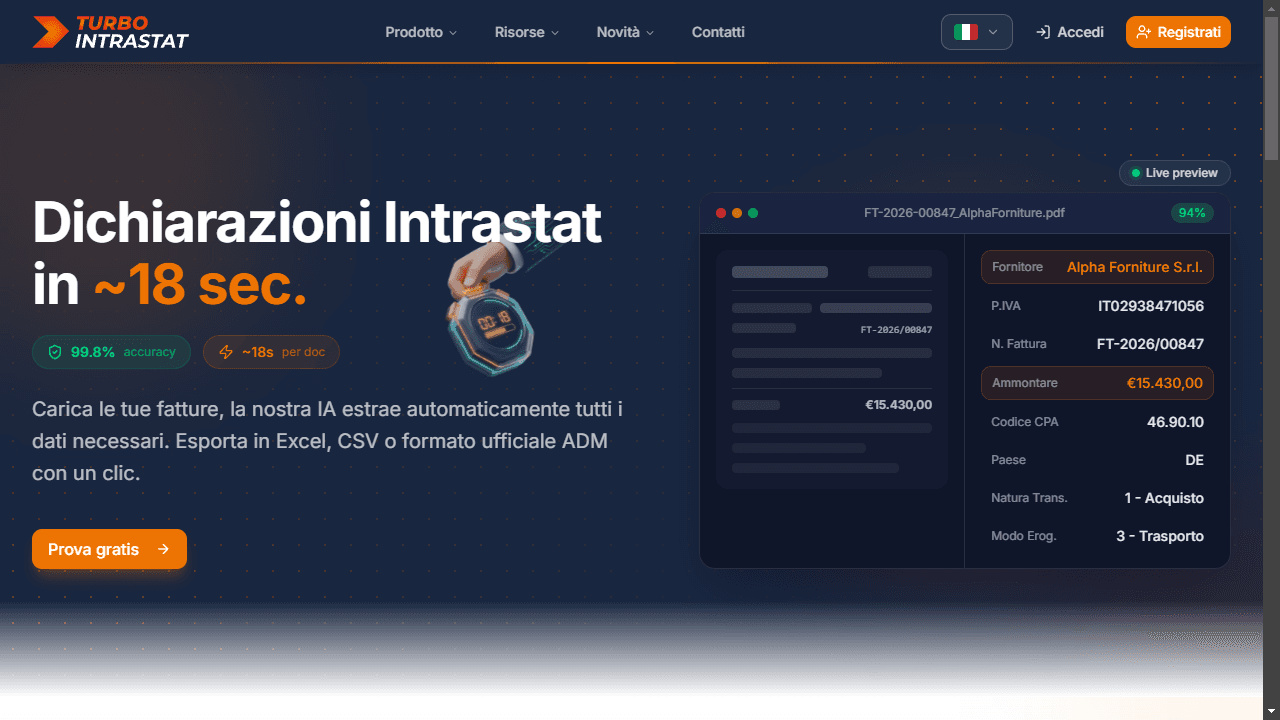
TurboIntrastat
AI-powered SaaS platform to automate Intrastat declarations. Marketing site + webapp live at turbointrastat.com
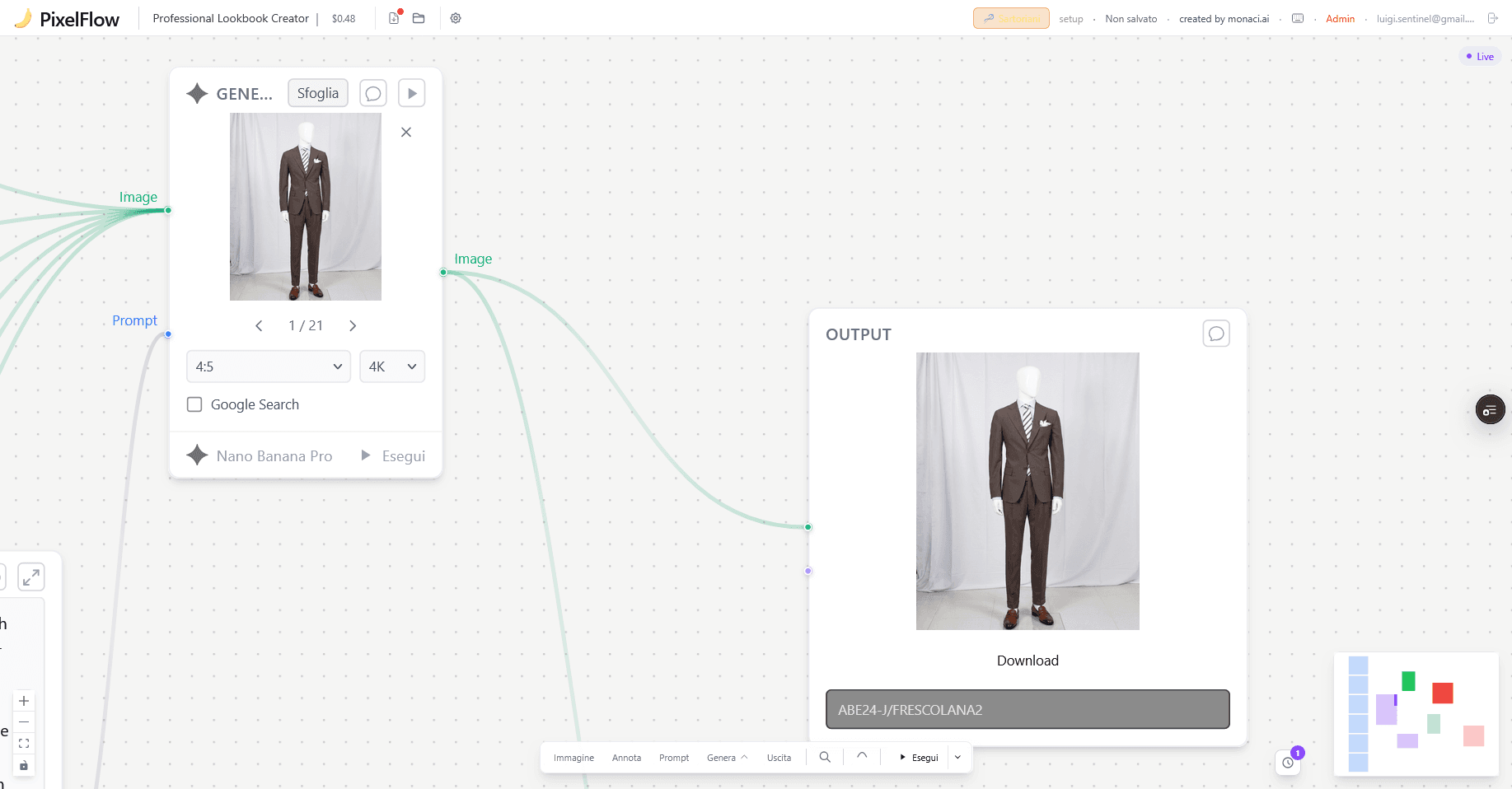
PixelFlow
Visual node-based studio that automates AI creative generation pipelines, with batch processes that run entire catalogs autonomously and only require human review at the end. Used in particular to produce fashion-industry content: lookbooks, garment variants, virtual try-on and social campaigns.
Frequently asked questions
Will my data end up training OpenAI or Anthropic models?+
No, when we use their enterprise APIs (no-training by default) or when we deploy open-source models locally via Ollama or vLLM. We document the data flow in writing before kickoff.
How much does a custom AI system cost?+
For a defined-scope POC (RAG chatbot over internal documents, single-tool agent) we start at €10k. For production implementations with multi-agent, integrations and MLOps we're at €25k and up, scaling with the number of tools and data sources. We provide a concrete quote after discovery.
What is RAG and when is it better than a simple chatbot?+
RAG (Retrieval-Augmented Generation) lets the LLM answer based on your up-to-date documents instead of generic training. It's worth it when accuracy on internal knowledge is critical (support, legal, medical, technical domains).
Can I switch LLM provider after launch?+
Yes, we always architect with an abstraction layer that allows swapping OpenAI, Anthropic, Gemini or local Ollama models without rewriting business logic. Zero lock-in on the provider.
How do you evaluate the quality of generated responses?+
We define evaluation metrics together (relevance, factual accuracy, tone), build a golden test dataset and measure every release against the baseline. No 'it works well' without numbers.
Can you integrate AI into our existing systems (CRM, ticketing, email)?+
Yes, via APIs, webhooks, n8n or custom MCP servers. Solid experience integrating with Supabase, HubSpot, Zendesk, transactional email and internal knowledge bases.
What does deploying a custom MCP server mean?+
MCP (Model Context Protocol) is the open standard that allows Claude, Cursor and other AI tools to securely access internal tools and data. We build MCP servers that expose your internal APIs as tools callable by AI assistants.
How we work
Our agency process in 5 steps
- 1
Discovery & Spec
We analyze goals, constraints and KPIs together with the client's product team. We define scope, deliverables and acceptance criteria before estimating — no estimates on fuzzy scope.
- 2
Architecture
We design the data model, external integrations and contracts between modules. No code before the map is clear: you save weeks of downstream refactor.
- 3
Iterative development
Short cycles with weekly client demos, dedicated branch per feature, continuous code review. Every release is production-ready, not a throwaway prototype.
- 4
Review & test
Automated tests, QA checklist, security and accessibility audit before release. No surprises in production, no incidents in the first 48 hours.
- 5
Deploy & handover
Production deploy, operational documentation and training for your internal team for full post-project autonomy. You can continue with us or hand off with no hidden dependencies.