

I distinctly recall a conversation about eighteen months ago with the CTO of a manufacturing SME, a company of around 70 employees. They had developed a promising forecasting model for supply chain optimization, but moving from prototype to production was a dead end. The development environment didn't match deployment, dependencies broke with every update, and inference was so slow it nullified the model's benefits. Every attempt to scale meant weeks of extra work for their small IT team. Today, new developments in the open-source landscape are radically changing that picture, making advanced MLOps and LLM inference optimization no longer a luxury for big tech, but a tangible possibility for businesses of all sizes.
The artificial intelligence landscape is moving at such a pace that staying updated is a challenge, but ignoring trends can mean losing a competitive edge. In recent months, I've observed a significant acceleration in the development of open-source tools aimed at making AI model implementation and management more efficient, secure, and scalable. These aren't just 'revolutions' in rhetoric, but incremental improvements that, when combined, generate a remarkable practical impact.
Three Key Innovations for AI Scalability
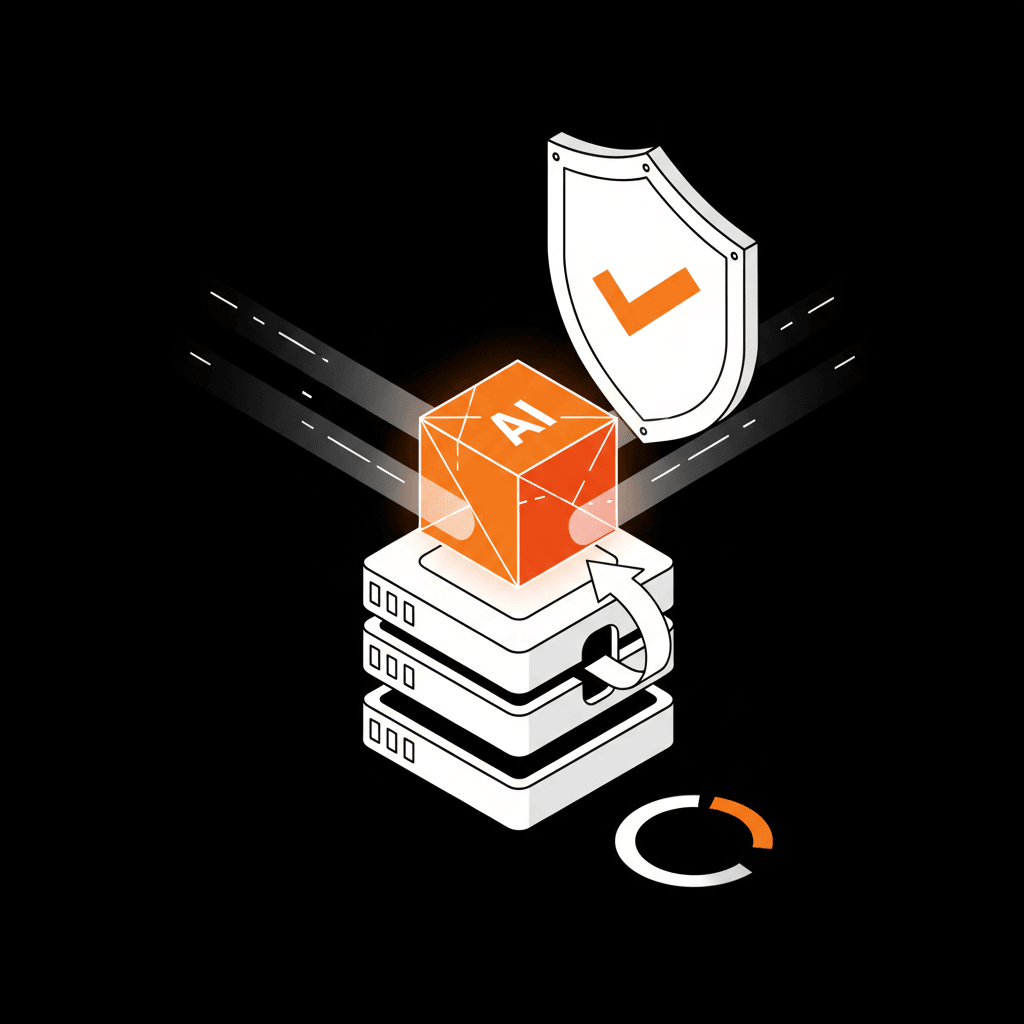
These developments focus on critical areas: model loading security and speed, LLM inference efficiency, and ease of development and fine-tuning.
-
Safetensors: Secure and Fast Model Loading. How many times have we downloaded a pre-trained model from the internet, only to wonder about the potential risks of arbitrary code execution? Safetensors solves this. It's a serialization format for model weights that is inherently secure, preventing malicious code execution. But that's not all: it's also incredibly fast. It loads models in milliseconds, regardless of their size, by avoiding full data copies to memory. This translates to faster AI application startup times and a significant boost in security, which is essential in production environments where every millisecond and every potential vulnerability matters. For an SME, this means being able to integrate new models with greater confidence and agility, reducing waiting times and cyber risks.
-
vLLM: The Art of Efficient LLM Inference. Inference for Large Language Models (LLM) is notoriously expensive in terms of computational resources and latency. vLLM is an open-source Python library that directly addresses this issue, dramatically improving throughput and reducing latency for LLM inference. It employs advanced techniques like paged attention, which optimizes GPU memory usage. The result? A single GPU can handle a much larger number of concurrent requests compared to traditional implementations. This is a game-changer for anyone looking to deploy LLM-based chatbots, AI assistants, or text generation systems in production. Imagine serving three times as many customers with the same infrastructure, or substantially reducing the cost per query. For our team at Logika.studio, it means we can test and deploy custom LLM solutions with previously unimaginable efficiency, allowing our clients to get the most out of their AI investments.
-
Gradio and TRL: Rapid Development and Accessible Fine-tuning. Gradio allows you to create web user interfaces for AI models with just a few lines of Python code, making prototypes and demos accessible to anyone in record time. Say goodbye to long front-end development sessions just to showcase an idea. TRL (Transformer Reinforcement Learning) is another Hugging Face library that simplifies LLM fine-tuning with Reinforcement Learning from Human Feedback (RLHF) techniques, crucial for aligning models with specific business needs. Together, these tools democratize access to advanced AI development and customization, a point we've often highlighted as crucial in a previous article of ours.
What This Means for Developers and Decision-Makers in Italy

For a CTO or founder of an Italian SME, these developments mean concrete opportunities. It's no longer necessary to have a team of dozens of experts to implement advanced AI solutions. With Safetensors, the model integration pipeline becomes leaner and more secure. With vLLM, even on limited budgets, it's possible to achieve competitive LLM inference performance, paving the way for internal chatbots for customer support or sales process optimization, without relying on expensive APIs with high per-token costs. Gradio and TRL then accelerate the entire AI product lifecycle, from prototyping to deep customization, reducing 'time-to-market' and enabling faster iteration based on real feedback. This is a fundamental step for companies looking to adopt AI not just as a tool, but as a strategic lever for innovation and operational efficiency.
Limitations and When to Consider Alternatives
Despite significant progress, it's crucial to acknowledge that these solutions are not a panacea. MLOps, even with advanced open-source tools, still requires a certain level of expertise to be implemented correctly. Managing underlying infrastructure, configuring monitoring systems, and orchestrating pipelines remain tasks that benefit from experience. Regarding LLM inference with vLLM, while efficient, the hardware requirements (powerful GPUs) for larger models can still be a barrier for smaller organizations. Furthermore, for use cases where data privacy is extremely critical or regulations are stringent (such as in some financial or healthcare sectors), on-premise LLM implementation, though facilitated, requires careful evaluation of security and governance implications. When internal resources are extremely limited or a project demands rapid escalation without the burden of infrastructure management, fully managed SaaS solutions or proprietary model APIs can still be a viable alternative, albeit with potentially higher long-term costs.
At Logika.studio, we adopt a technology-agnostic approach, always evaluating the best stack for the client's specific needs. Developments in the Hugging Face open-source ecosystem, particularly tools like Safetensors, vLLM, Gradio, and TRL, represent a clear direction towards greater AI democratization and efficiency. They offer new possibilities for Italian SMEs to implement robust, scalable, and secure AI solutions, with greater control over costs and infrastructure.
If you want to delve into a similar case, a free 30-minute audit is available at audit — quick analysis, 2-3 concrete points, zero pitch.